
Exciting new wound-healing study shows promising results
A collaboration between researchers at Roskilde University and the University of Coimbra in Portugal shows results that may prove significant in the long term for diabetes patients struggling with leg and foot ulcers.
Together with her research group, DDA-funded postdoc Anja Elaine Sørensen of Roskilde University is attracting attention with an exciting new research article on wound healing in the scientific journal Scientific Reports (https://www.nature.com/articles/s41598-019-42309-4).
In the future, this study may prove significant for those diabetes patients who struggle with wound healing on their lower legs and feet. And that’s a lot of people – there are 3,000 new cases every year.
Chronic foot ulcers are one of the most serious complications of diabetes, both type 1 and type 2. The condition presents as a combination of impaired sense of touch – these patients may have a stone in their shoe without noticing it, for example – and poor vascular circulation, which means that their wounds do not heal as well.
‘Current treatment of lower leg and foot ulcers is very conservative, and there are not many interventions to make the leg heal by itself. Patients are most often sent to a vascular surgeon, and then, once blood circulation has improved, a podiatrist can clean and relieve the chronic ulcer until it is healed. So, there is certainly room for a treatment to be found that will make the tissue heal better by itself’, says Anja Elaine Sørensen.
And finding a better treatment for diabetic foot ulcers is precisely the mission that Anja Elaine Sørensen and her research group have taken on. Specifically, by studying the effect of RNA molecules on wound healing in diabetic mice, and seeing whether inhibiting certain RNA molecules during wound healing might have a positive effect.
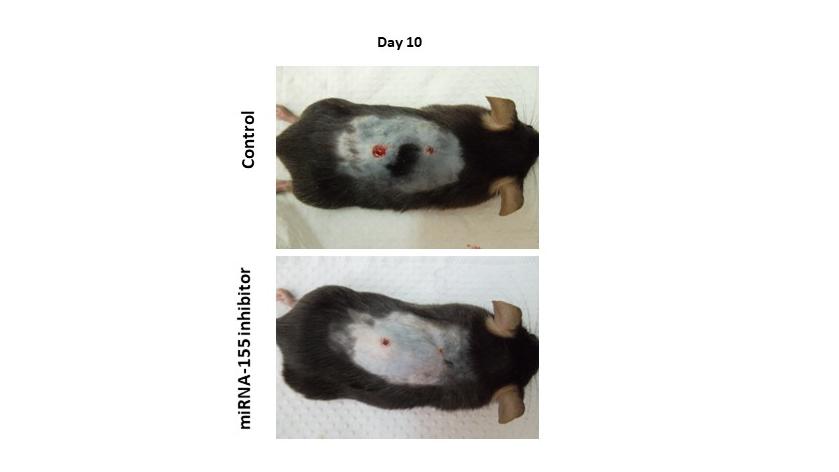
‘Basically, we show that the skin’s content of small RNA molecules is markedly changed in diabetes – measured in a diabetic mouse model – and that this has an impact on wound healing. We chose to look at the microRNA 155 molecule specifically, and there we could see that, by inhibiting it in a diabetic mouse, we could promote wound healing significantly. The interesting thing was that we carried out a very mild treatment – dripping the inhibitor on twice a day for three days – and that was quite enough both to obtain faster healing and less inflammation, and also to demonstrate an increased volume of growth factor in the skin’, explains Anja Elaine Sørensen.
The research group describes the results of the study as both striking and promising, and they are looking forward to investigating whether the same positive results can also be achieved on human ulcers.
‘For example, you could compare healthy people’s ulcers with people who have diabetic ulcers. Another thing worth considering is that we have only tried altering a single microRNA. It could be interesting to see what happens if you inhibit several different microRNAs’, says Anja, who emphasizes that it is of course far from guaranteed that the new results achieved with mouse models are transferable to human skin.
The Roskilde University researchers are not the only ones involved in the new study, however. Obtaining these remarkable results depended to a significant extent on close collaboration with other researchers, particularly from the University of Coimbra in Portugal.
‘I know the leader of the Portuguese group well, as we were postdocs at the same place. They are mouse model specialists, and they approached me and asked whether we would like to study some of their trials. Everyone wins with that sort of collaboration: we can share experience and knowledge, as we each have our areas of expertise’, says Professor Louise Torp Dalgaard of the Department of Science and Environment, another member of the research group.
In addition to researchers from Roskilde University and the University of Coimbra, researchers from the University of Southern Denmark also contributed to the study.
For more information on this research visit RUC (in Danish).